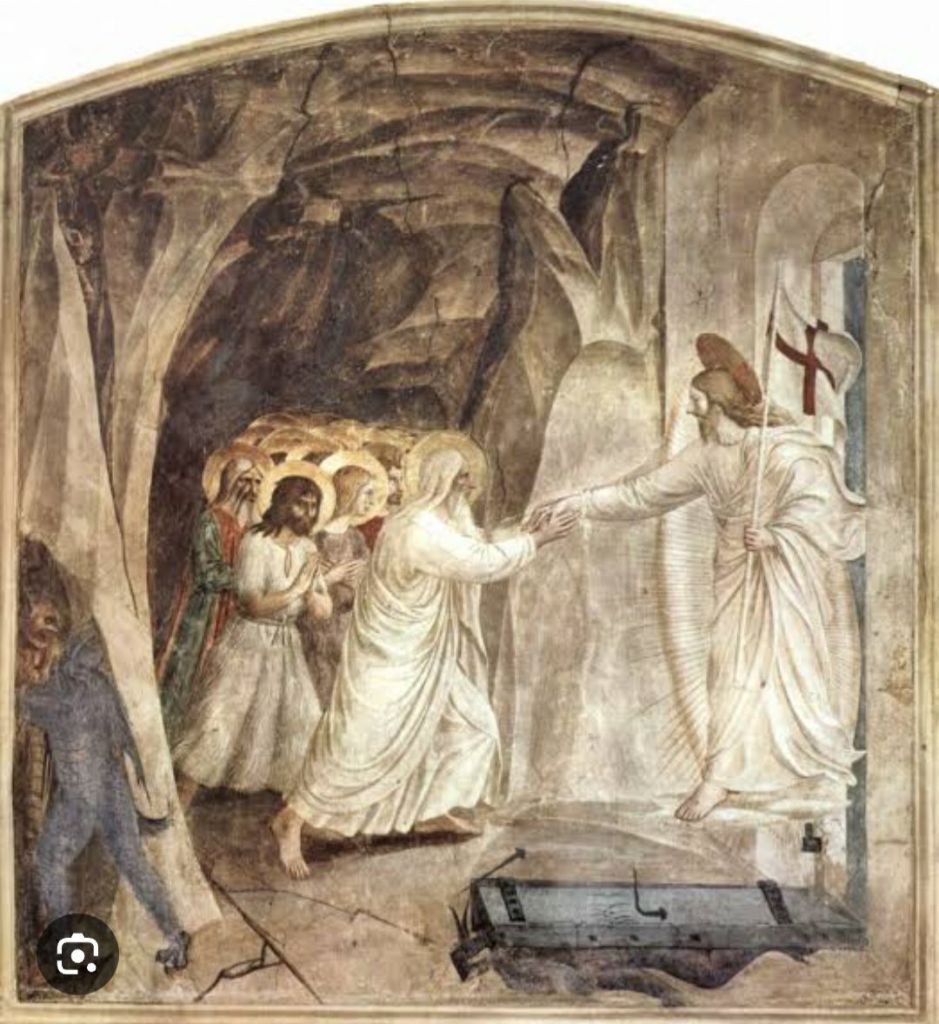
During the year of Our Lord’s Passion, the Passover as it was celebrated according to Jewish Tradition was actually celebrated on Holy Saturday. Before His death at Calvary on Good Friday, Jesus celebrated the same Passover with His disciples on the Thursday because He foreknew the timing of events and as such nothing is a coincidence. And in celebrating the Passover, Jesus did two things, both of which relate to each other and to the future of our world. He firstly celebrated this feast in honour of the ancient Jewish custom that represents the liberation of the Hebrews from slavery in Egypt. Secondly, He did this as a further extension of its original representation so that the liberation from slavery to sin, death, and evil would be merited by Him on behalf of the entire human race, and indeed the whole of creation, which had up until His resurrection from the dead, been groaning in travail for the Day of Redemption in a primordial sense. Even though the primordial pangs of this groaning had been fully, unreservedly, and unalterably obliterated by Christ’s resurrection, we are, all of us, still experiencing the groan of our temporal limitations which will only be completely removed once we enter fully into that Heavenly state of adoption, of sonship that Jesus’ rising from the dead also won for us and rightly positioned, in the realm of our Eternal future. (Rom. 8 : 19 – 22) ²
Therefore, on the very first Holy Thursday, Jesus rendered a completely new level of meaning to the Passover, and whilst not cancelling out it’s original meaning, by instituting the Sacred Rememberance of His Passion through the celebration of the Eucharistic liturgy, He pointed to its completion through His own Passion, Death, and Resurrection – that Primordial Consumation of the work which the very first Passover that occured on the night of the Exodus, the Crossing of the Red Sea by all the Hebrew slaves in Egypt 1477 years prior, had set into motion.
And so, because of this Passover of Jesus as our Pascal Lamb, sacrificed once and for all in atonement for ALL our sins – that is, all the sins which were ever committed since the Fall and all that will be committed unto the End of Time, we have also what we might call “a Passover within a Passover”. And we see this come forth like the Spring in two senses, the first of which we have already explored above. The second sense relates to how on the night of the Jewish Passover, which has become our Holy Saturday, Jesus rises from His death, and goes first on mission to the spirit world as He descends into Hades, into Hell, or the world of the dead below, in order to take back the keys of death and Hades from His adversary, the Devil, effectively defeating this adversary’s power and his holding to bondage and captivity all our souls. The souls of all those too who had ever passed away prior to Jesus’ Passion are also freed from their waiting around so to speak, in Hades. This immediately precedes His bodily resurrection on the early morn of Easter Sunday. And so the message foretold in Isaiah 61 is accomplished once and for all in the realm of the spirit. The Devil has been vanquished, all the powers of Hell shaken unto defeat. The captives are released from Hell. Hell has been harrowed by the Rising of Christ victoriously from the dead.
References
1.) Digital Commons: The Anastasis (The Harrowing of Hell) – Fra Angelico, c. 1440s, Fresco, Monastery of San Marco, Florence, Italy.
2.) The concepts brought forth in this reflection correspond to these passages from Romans 8 : 2-3, 15-25
“2For in Christ Jesus the law of the Spirit of life set you free from the law of sin and death. 3For what the law was powerless to do in that it was weakened by the flesh, God did by sending His own Son in the likeness of sinful man, as an offering for sin…15For you did not receive a spirit of slavery that returns you to fear, but you received the Spirit of adoption, of sonship, by whom we cry, “Abba! Father!” 16The Spirit Himself testifies with our spirit that we are God’s children. 17And if we are children, then we are heirs: heirs of God and co-heirs with Christ—if indeed we suffer with Him, so that we may also be glorified with Him…18 I consider that our present sufferings are not comparable to the glory that will be revealed in us. 19The creation waits in eager expectation for the revelation of the sons of God. 20For the creation was subjected to futility, not by its own will, but because of the One who subjected it, in hope 21that the creation itself will be set free from its bondage to decay and brought into the glorious freedom of the children of God.
22We know that the whole creation has been groaning together in the pains of childbirth until the present time. 23Not only that, but we ourselves, who have the firstfruits of the Spirit, groan inwardly as we wait eagerly for our adoption as sons, the redemption of our bodies. 24For in this hope we were saved; but hope that is seen is no hope at all. Who hopes for what he can already see? 25But if we hope for what we do not yet see, we wait for it patiently.”
Discover more from My Catholic Blog
Subscribe to get the latest posts sent to your email.
 My Catholic Blog