This Sunday just gone is known in the liturgical life of the Church as not only the Fourth Sunday of Easter but it is also called Good Shepherd Sunday. It is a time when we reflect on the meaning of seeing in Jesus – our Good Shepherd – the One Who cares for us, nourishes us, calls us to Himself as His lambs, the sheep of His very own pasture. For He loves us so:
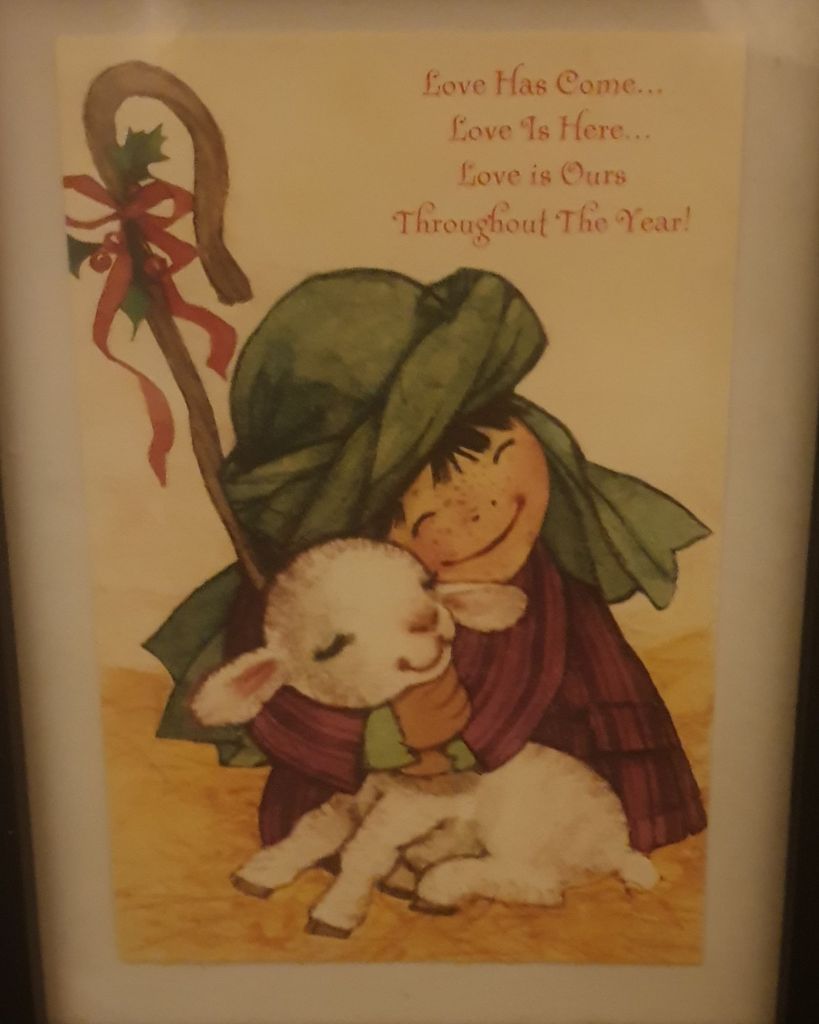
Even though there may be many times perhaps when it can be a challenge to understand this and/or perceive and know deeply the reality that it truly affords us, other times however, are very different and it is simple to trust, to see and hear and feel His love as aptly and brilliantly as it is conveyed in the picture above. Because in order to be able to clearly hear the voice of Jesus, our Good Shepherd, we need to take the quality-time to develop this “hearing, this listening capacity”. And that is in perfect alignment with the Order of Love, that inspiration which comes from St Thomas Aquinas in its original Latin as Ordo Amoris, as this concept describes a work of God’s love in progress. At this point, I would like to cite a quote from a commentary¹ on Sunday’s Gospel by Sr Mary McGlone from St Mary McKillop’s order, the Sisters of St Jospeh. She states that:
“Hearing means paying serious attention, allowing a message to move our heart like music moves our feet, allowing it to get deeply into us. Thus, Jesus could claim that those who hear Him follow Him. Imbibing this message, they recognize it as so life-giving, that any other option seems pointless.”
So, it is with this firmly in heart and mind then, that I turn attention to the relevant thematics of the following article from the National Catholic Reporter called JD Vance is Wrong: Jesus Doesn’t ask us to Rank our Love for Others. This article can be accessed here:
And it is now that I shall offer my commentary in respect to both the message of Sunday’s Gospel (John 10 : 27-28) where Jesus talks about the characteristics and nature of how He shepherds us and from there I seek to draw some corresponding relationship to another related Gospel passage I also heard recently from John 10 : 16, where there is a valid connection between this and last Sunday’s Gospel. This too, ties in with the message conveyed by Our Blessed Mother, who, on the 13th May 1917, supernaturally appeared to three shepherd children, in Fatima, Portugal. Today (being the 13th May), honours this feast and is so called within the life of our Church, the Feast of Our Lady of Fatima.
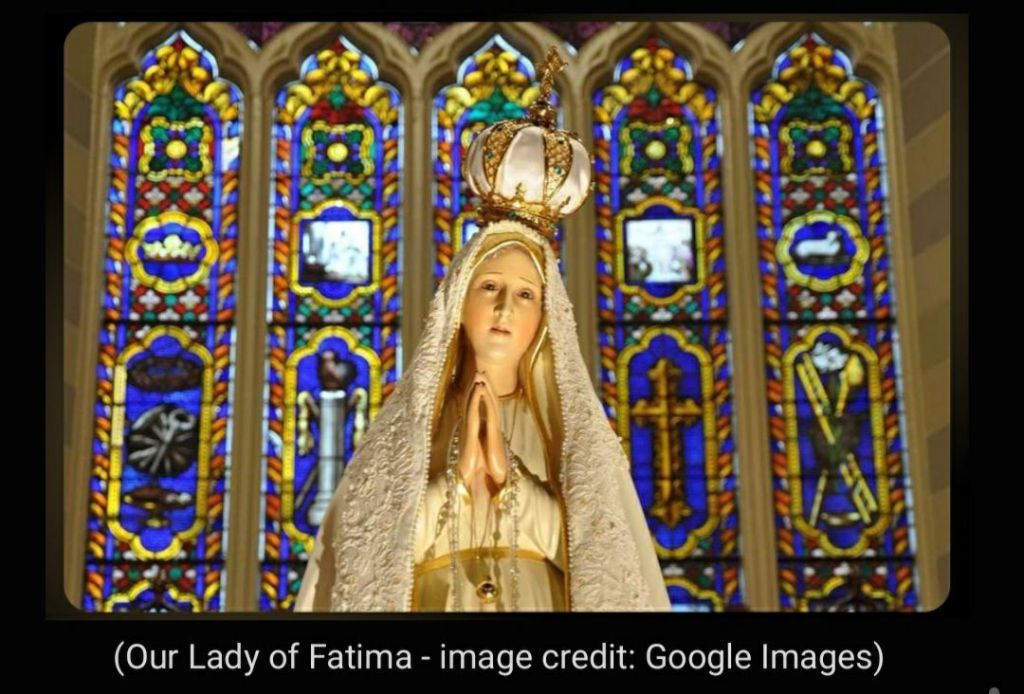
The Fatima message was about the need for our world to repent of the destructive warlord mentality that had so infernally gripped it, and instead beat our swords into ploughshares, reconciling differences, thereby striving to live at peace with one another under the universal reign of the Good Shepherd. And so this superlatively necessary and timely message applies to us all today just as much, and not just the three young seers who directly received the message alongside those many other people who lived at that time. For in John chapter 10 verse 16, we hear Jesus making the point that He has different sheep-folds too, not just one, even though when seen together under His eternal reign as the Good Shepherd, all these distinct folds belong to one united flock, having communion under the Standard of Christ. This serves well to remind us of the need to be humble in extolling the virtues of our own fold. It does not mean we dim them down but it does mean we exercise a diligence of welcome to those of other folds who may appear so different from us, rather than becoming exclusivistic and cliquey preferring instead to remain huddled within our own crowd while shunning these others, who though friendly & warm, are nonetheless too different from us, yet they still desire to enter into some kind of meaningful dialogue with us but we remain aloof. This then is the conflict, the rootedness in senseless division, that our Blessed Mother beckons us, for the sake of her Son and the wellbeing of all life, to cast off as chaff. There is an Ecumenical spirit attested to here – something which by necessity, compells Jesus to extend His universal reign to all – including folds outside of that or those to which we personally have some measure of intimate union. This brings me to the next theme, that highlighted in the title of this post and briefly touched upon earlier, namely the Order of Love.
While reading an article I saw on LinkedIn from the Christian Science Monitor² in the last few days or so about the election of our beloved new Pope Leo XIV, there was a somewhat brief mention of a moment in January of this year, when after having heard the rather unempathetic stance of JD Vance on migration and other related issues, (i.e. how far does the Gospel exhort us to extend charity on various levels, whether personal, familial, societal, national and international spheres), the then Cardinal Robert Prevost (now Pope Leo XIV) took it to task to rebuke Vance for having misconstrued the notion of Ordo Amoris, which is worth reiterating here, essentially a Thomistic notion regarding the common sense of “blooming where you’re planted”. It’s literal English translation is the Order of Love and the essence of it’s teaching essentially aims to follow the natural progression of life from the womb through all differing life stages of our “core love development” as persons. It’s an exemplary model for us to follow and what the then Cardinal Prevost was trying to say through that rebuke, is that this trajectory needs not to be used to bolster laziness of charity but instead needs to be seen in light of its original Thomistic paradigm, that love is patient as well as kind. That is, patient in terms of each one’s qualities, gifts, resources, for we are not all endowed in exactly the same way or measure and therefore some are suited for here and others there, and all of us yet still, progress through our various developmental life-stages at differing paces and in vastly different ways. And true God-given love is at one and the same time, kind in that it engenders a deep, yearning flame of compassion and affection within, a flame that burns with the brightness of purity inasmuch as it does with intensity. So while patience is essential in recognizing that our respective gifts, talents, and abilities all take time to develop to their fullest potential, the kindness of love is an absolute necessity and needs to accompany this progressive development every step of the way, for without that, people become as empty clanging cymbals (1Cor 13:1), which essentially is the inverse of the overture of praise rendered to the Lord in Psalm 150:5
Praise Him with a clash of cymbals; praise Him with loud clanging cymbals
Because authentic charity embodies a compassion that by its very nature renders a certain type of praise to God equivalent to that described in Psalm 150:5, this is why St Paul said that ‘service’ without love accompanying or defining it, is as meaningless as clanging a pair of cymbals for no good reason. See, we can still make attempts to do all these seemingly wonderful and charitable things but at the end of the day, the quality of how we did them, the measure by which we pour out the love of our hearts in the act of doing is apparently more important than herculean efforts alone to “get stuff done”. And further still, do we actually pour out love while “getting stuff done” or do we merely do the stuff out of purely logistical motives combined with purely logistical methods?
Besides, it’s also perfectly understood that not everyone can do everything – we are not God – only God can do and cover literally everything that needs positive transformation. Further, let it not be misconstrued therefore in light of the quote from Philippians 4:13 wherein which St Paul states I can do all things through Christ Who strengthens me. For, what is this all things? It cannot and should not be taken to mean literally ALL things as that too would include sinful things in conjunction with all good and necessary things. No! It refers specifically to that comport of tasks to which God specifically calls each person to accomplish. And with that, there are always set boundaries according to the precise gifts, talents, abilities, natural endowments and so forth that accompany each one’s respective development of these throughout their life. And those boundaries are there for a reason. This is what St Thomas Aquinas was referring to when he exhorted readers to acknowledge the relevance of Ordo Amoris. It’s a precaution too, against recklessness and foolhardiness in reaching out beyond one’s God-given capacities. It’s not saying though, that our hearts need to be hardened against events or circumstances calling for redress from far away. Not at all. And that was indeed the crux of the matter Cardinal Prevost was getting at. Acting within reason does not mean not caring or not acting at all. It’s simply stating that we ought to love and act from a reasonsble position, rather than not doing anything; that is, acting thereby from a suitable place and time of equipping, rather than doing nothing at all or stepping into something or somewhere we are not called to nor are particularly equipped to deal with at any given point in time. That said, it must also be remembered that equipping can and does change. In one moment, we are only ready for A or B when a few months or years later, we find ourselves possibly ready for C or D. So the concept of Ordo Amoris is about using common sense in discerning where to put our time, talent, and resource-power to effect the best, that is, the most loving outcomes in view of the needs most pressing, and those that are within our ability to help meet in the most loving way possible. It’s also sobering to recall the time when Jesus was tempted in the desert where the devil asked Him to jump of a high cliff because He could ‘do that’ as He, being the Son of God, would be soon rescued by His angels should anything go amiss as He jumped. Now, that is the temptation to both recklessness, and to ‘proving something’ to someone who has not the best interests of you or anyone else in the whole wide world in mind or heart for that matter.
Therefore, it would do us well to remember that natural progression’s one important thing in a learning curve alright, as per the example I like to cite of Jelena Dokic ³ and how she progressed from honing her skills on her local home tennis turf before gradually building her experiential base and winning tons of local matches which then helped her to progress further afield, expanding her circumference, getting then into the state and national selections and finally, after much grind, grit, and determination, she became pro on the womens WTA tour. Although I am keenly aware of and robustly sympathetic to Dokic’s many hardships, struggles with her father’s chronic abuse, and subsequently her serious lack of positive family life insofar as the turmultuous relationship with her father went, it is not the subject of this particular essay to go into the many ins and outs of those troubled areas in her life, but I just needed to make it clear to readers nonetheless, that I was using her developmental example regarding her tennis career as an illustration of what is meant when we talk about “blooming where you are planted”. Another catch-phrase in this area is “think globally, act locally”, meaning that while we act on home turf, we are nevertheless compelled by charity and the witness of the Gospel, to be also championing the global sphere insofar as our desire and heart to reach others in most need goes. Through this, it is possible to make our localized efforts produce positively transformative global impacts. This points to the fact too, that our labours of love ought to be decisively intentional and that when & where we are not able to physically travel or accompany in-person, we can do much through the spirited power of prayerful witness and intercession. Btw, contrary to some misconceptions, this is not laziness but indeed spiritual fervour and solidarity in-absentia. How many of you are aware of what cloistered monks and nuns do for the whole world? They may not physically go out into the wide world yonder to do this or that in striving for a better world in light of the Gospel. That is because their charism is not extrovertedly evangelical or missional – it is not “active” in that way but it is neither tepidly “passive” either. Rather it is called “contemplative” because they are 24/7 devoting their lives to a sacrificial service of prayer and intercession for the sake of the Gospel, the betterment of our world, and the salvation of souls.
So, the Order of Love (Ordo Amoris) as mused upon by St Thomas Aquinas, is more intrinsically about a natural progression in one’s development. It’s seriously about blooming where you’re planted and then traversing further afield, if and when called, once your experience substantially readies you for that. That is really what is meant by the concept of “charity begins at home”. Notice the words – it says “begins at home”. Yes, it’s meant to begin there and flourish there. Hence the relevance of the following quote from the NCR article which my blog post here essentially addresses:
“Paul reminds them: love starts close. It moves first toward those in front of us, ensuring widows were not abandoned while preserving the church’s resources for those truly without support. But make no mistake — this isn’t about love confined to bloodlines or geographic boundaries. It’s about love rooted in responsibility, expanding outward. And it was subversive even then.”
That said, it also means it’s not rigidly confined to the hearth of one’s home. It has to, by a necessity of natural growth, spread wings while remaining rooted in the hearth’s life-giving embrace. But for this to be done well rather than recklessly, robust and thorough immersive preparation is needed more or less solidly on home turf. Otherwise, if not, things become brittle, weak at the links, and then it’s frighteningly easy to become an uprooted prodigal who drifts towards oblivion. Hence the wisdom and integrity of starting one’s ventures and enterprises close to home, and starting small. After all, Rome, as the Eternal City, wasn’t built in a day.
Equally true though is the following:
“Colonial ideology has conditioned us to think in binaries and hierarchies — who is in and who is out, who is first and who is last. We struggle to fathom a love that is not ranked, that does not sort people into categories of worthiness. But Jesus seemed to be inviting us into a different world altogether — one where love moves freely and without hierarchy, breaking down the borders we’ve been taught to build.” ⁴
Hence the spectre of war loomed large during the days of “Rule Britannia, the Tsars, and Kaisers”, and whoever else ruled the roosts of political machination back in the time just prior to the turn of the 19th century into the 20th. And it makes sense too that Mary, our Mother should come and appear in the midst of us at Faitma in 1917 to tell us of how grieved Heaven is because of humanity’s stubborn unwillingness to choose the voice of reconciliation through peaceful dialogue and engagement over the terrible clammor of tanks, gunfire, and bombs.
Thankfully though, since the end of the Second World War, many nations in Europe and the Commonwealth have largely turned away from the use of arms and force in making necessary political, social, and economic adjustments and decisions. At long last nations such as Britain and France have ceased from using brute force to make political statements or stake claims. But tragically too, many other nations unfortunately are still way behind in wisdom on multiple levels in these areas and hence the reason why we repeatedly see the manifold destruction all around brought about by the unwillingness of some to achieve peace and mutual understanding through simple, constructive dialogue instead of the senseless brute force of the clash of arms. And this brings us back to the thematics of the last quotation, that “ranks in worth or worthiness” are intrinsically fallacious and profoundly out of touch with Gospel values, which is why preferential treatment of some groups as opposed to others along nationalistic lines, is actually at odds with the message our Lord and Saviour offers for the liberation of the world and the salvation of souls. This too, is why it is just so brazenly bizarre to hear some who take great pride in declaring their allegience to the Catholic faith or to the Gospel generally, but who also will – get this – given the slightest opportunity to do so, not hesitate to go about spreading all kinds of rancor and divisive sentiments based on some ribald, albeit very secular, nationalistic or patriotic fervour. And this is precisely the type of unkind sentiment that seems to characterise much of the MAGA camp’s ideological paradigm, see:
https://myfaithandlifeblog.com/2025/04/25/maga-is-just-about-as-catholic-as-a-rapper-on-steroids/
Because there has been a resurgent popularity or shift towards such polarizing perspectives in more recent times, this underscores the need to challenge and confront these in such a way that brings clarity where there is confusion, understanding and conviction where there is doubt and ignorance; and a definitive, rejuvinated hope and resilience where there is resignation, disillusionment, and despair. Sometimes too, these kinds of faith-bolstering words are easier said than put into a personal witness of consistent and unperturbed practice but let it also be said, that every step in the right direction is essentially a steady work in progress.
Other References:
¹ McGlone, M., ‘Fourth Sunday of Easter: Checkmating the Devil’ in National Catholic Reporter (online edtn), see this URL:
https://www.ncronline.org/spirituality/scripture-life/fourth-sunday-easter-checkmating-devil
² Llana, S.M., & Ors., ‘Pope Leo’s Challenge: How to Build Unity in a Fragmenting World’, in The Christian Science Monitor, May 2025, see this URL:
³ Dokic, J., Unbreakable: The Jelena Dokic Story, 2017, 2024, Penguin Random House, Australia
⁴ Armas, K., ‘JD Vance is Wrong: Jesus Doesn’t ask us to Rank our Love for Others’, in National Catholic Reporter (online edtn.), see this URL:
Discover more from My Catholic Blog
Subscribe to get the latest posts sent to your email.
 My Catholic Blog