Even though there was some matter of contention I had with Stephen Auth in my previous blog post on the dangers of smug indifference, I must come to the table and say that I couldn’t agree more with him on the subject of how there is a pervasive spirituality that runs thematically through a myriad of artists’ works from the era of impressionism to post-impressionism & realism right through from Van Gough to Rodin. I was pleasantly surprised upon hearing the way Stephen Auth in EWTN’s Pilgrimage to the Museum: The Hypercube ¹ speaks about how Van Gough definitely has this illumination on the Divine shine forth through much of his work, and also about how Rodin in particular places perhaps one of his most well-known works, The Thinker above The Gates of Hell. And that’s just awesome because, Rodin’s subject here is not definitively consigned to the fate of the fallen angels but rather, he is eloquently positioned as reflecting in-earnest on how much of a mess everything is in because of the fall of one third of the angels in their disobedience to the love of God coupled with the awful ramifications of Original Sin. Moreover, we are confronted with this perennial question: who exactly is this mysterious thinker figure supposed to be? My ponderance asks is he Job or maybe an allegory of everyman, that is, every single human being that has ever existed, is currently existing or will exist? Stephen’s guess is that he’s a representation of Adam, only because he’s looking down on the consequences of his and Eve’s disobedience to God in falling to the temptation that was offered by the Devil, for them to ‘become like God’, but even more to the point, to see and experience things as ‘gods’ in their own right. And Stephen Auth supposes that the thinker figure is Adam reflecting upon the results of the Original Sin. Well, this is likely too, because apparently Rodin never expressedly mentioned who that figure was supposed to be. I thought maybe Job or a allegorical representation of everyman. And I supposed this to be the case because Rodin already did bronze casts of Adam and Eve in the same series, only that the precise theme there was about them getting expelled from the Garden of Eden. So I posited he may not have necessarily cast another Adam in the same series …..although, there is an equal possibility that he had chosen to do so as a way or means of telling different parts or episodes in the same story.
But I will again state my disagreement with Stephen Auth on Picasso’s work Blind Man’s Bread.² I think that instead of this work casting a shadow of complete doubt over the things and matters of God, I posit that it’s more a visual commentary or meditation if you will, on the nature of faith itself. Not that faith is necessarily blind although there is a trite and hackneyed saying that states this very thing about the need to at times, exercise blind faith or that love itself is blind. These idioms aside, there is a sense that Jesus begs the question of us to tell Him who exactly do we say that He is alongside there being this rendering of that which He said to Thomas when Thomas asks to see the wounds (in his side, hands, and feet) and only then will he believe. Now, are we being challenged here in Blind Man’s Bread to take the leap of faith, that leap characteristic of those who have not yet seen but still believe?
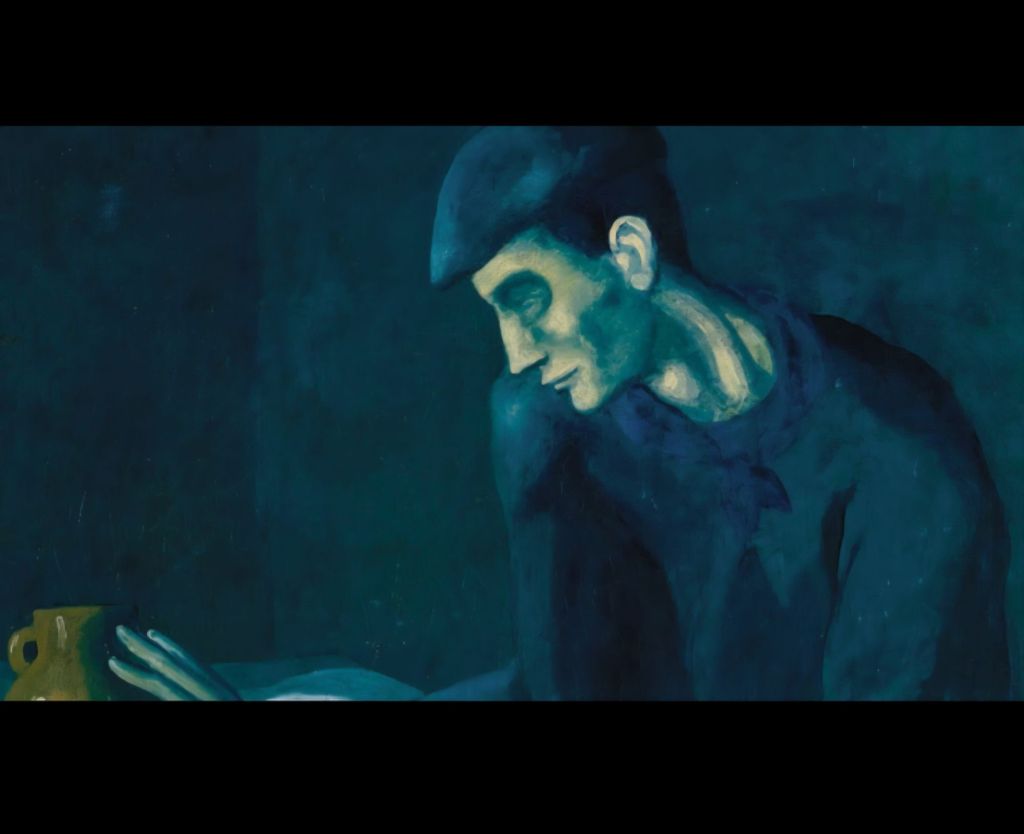
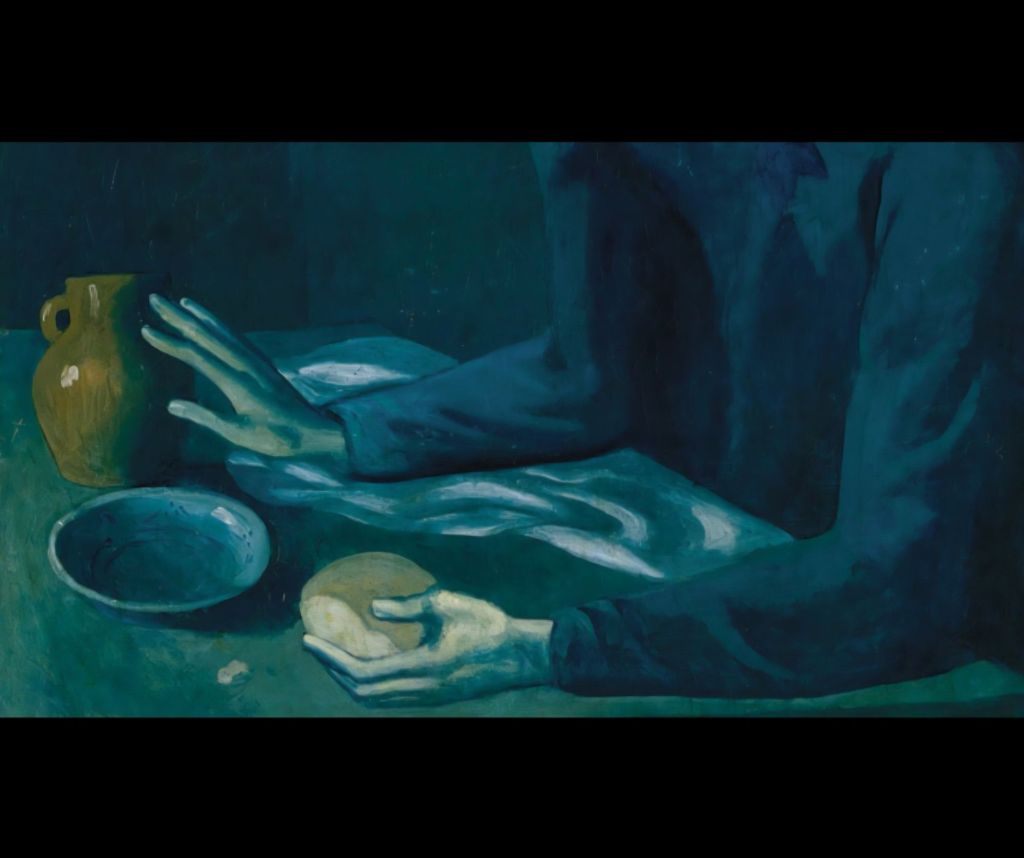
And still we are confronted with yet another question and that concern’s the precise manner of Thomas’ yielding to belief in the reality of the Risen Lord. For it wasn’t just a matter of him seeing alone. He also felt it necessary to touch the wounds. And there is something further so yearning in this desire to touch them rather than just see them. In Picasso’s painting we have the image of the bread being touched by a supposedly blind man. Are we to make of this man an allegory for St Thomas? C.S. Lewis talks about the four love-languages of God, although he classifies them a little differently to other writers who have explored the notion of theological aesthetics, and in particular the love-languages. And I will maintain that one of the most significant love-languages has got to be touch. This btw, runs through the entire breadth of C.S. Lewis’ Four Loves ³ as a common thread that links or unites them to one another as God so fashioned them. Because Jesus used touch in many instances to heal and restore and to simply express His profound love for those whom He encounters. I think this is potently meaningful on many levels because this ability to engage our surroundings by physically using our hands to feel the surfaces, contours, and textures of things is something that is a part & parcel of our being created by God as both physical as well as spiritual beings.
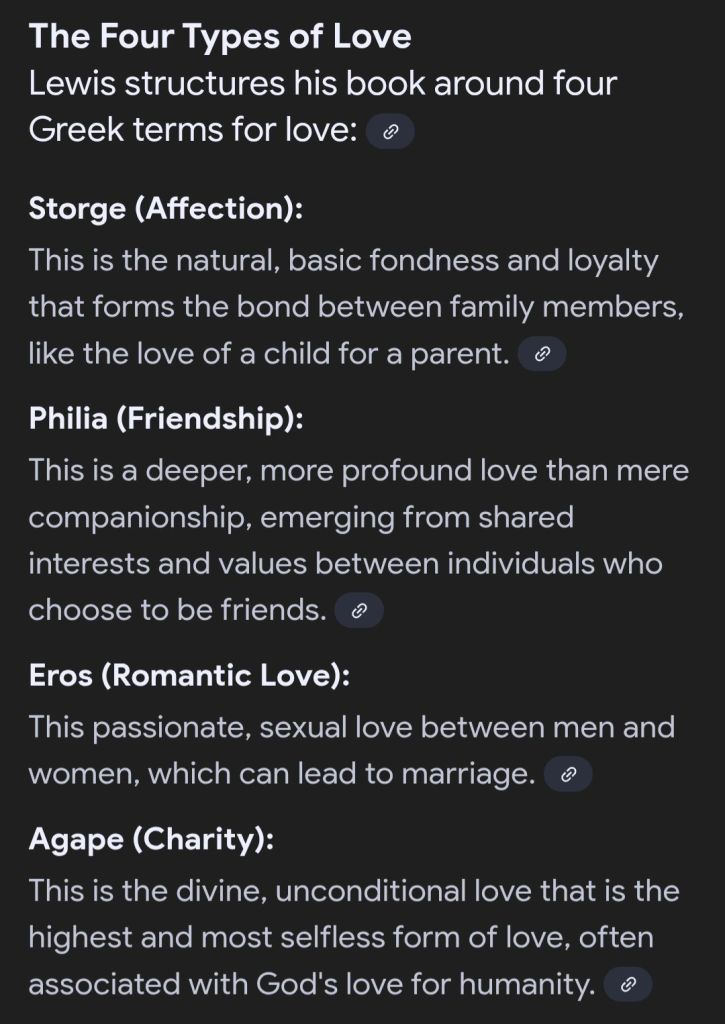
Continuing on to look at C.S. Lewis’ Four Loves, we need to adamantly state here that there is an Alpha & Omega relationship between Storge and Agape. Further, Storge is absolutely necessary if we are to know how to manifest Agape. Should Storge be cruelly torn or ripped assunder from our lives after we had known it so intimately, then Agape is terribly hard to find and we will struggle to manifest it, particularly if the return of Storge is delayed or the robustness of Storge is hindered by the constant imposing vexation of external circumstantial forces imputing into one’s daily experiential reality, gross disturbances of a spiritual nature that seriously hinder the consistent abiding of interior peace. It has to be purely by God’s grace then, given in response to our earnest plea for recompense, that we can finally come into a renewed experiential knowing of Storge in our life, and through this, cultivate and nuture the virtues of gratitude and appreciation for life once again. I truly believe that Storge is the premise upon which Pope Francis’ encyclical Dilexit Nos ⁴ was prepositioned. As it is only because He, that is, God, first loved us, that we are able to know and grow in love, in turn. And it is no accident that we experientially first learn about this amazing love of God for us, through Storge. However, it must also be recognized that there exists in this world, the tragedy of those who, through some circumstantial misfortune, never have the opportunity as children to experience Storge. That has got to be one of the worst things that could befall someone. Hence, our compassion needs to be switched on discerningly. And such a misfortune can be the stuff of a family life without love – one where there is only dysfunctionality, chaos, fragmentedness, strife, no love. It can be a situation of either/or relative to character development in these situations. William O’Meally, author of The Man They Couldn’t Break ⁵ certainly experienced some of this, a great burden of it actually because of his father’s strident alcoholism and how his mother suffered greatly at the hands of his unpredictable, tempramental, violent dad.
C.S. Lewis further goes onto explain how the type of love he designates as Philia is “deeper…than mere companionship” but I wouldn’t deign to describe it this way. In fact, I think companionship is a far too strong a word than his intention suggests. Therefore, it would be far more fitting to simply describe this kind of love as “a deeper and more profound love than mere acquaintance” since acquaintance canimply a more casual and therefore superficial type of relationship when compared to the profound depths of companionship that can be found in truly God-breathed Storge relationships. I think Philia resonates somewhere between that of acquaintance and authentic Storge. However, I must correct myself here too in that I now recognize that I was a little naiive when I said that the acquaintance level of relationship is by and large superficial. Because I have since learned that it is not necessarily that way in all situations although I personally have experienced it that way in many different contexts. However, I would like to emphasize that ideally, acquaintance should simply signify a beginning. But for those who have had a hard time successfully sowing into relationships, then beginnings more often than not tend to quickly fizzle out and the entire relationship becomes short-circuited as a result. That’s a tragic thing when this happens. But when such anomalies as the “relational fizzle-out” are for the most part absent, then an acquaintance level relationship is nothing short of a healthy beginning to more a robust and enduring friendship.
A great part of today’s problem in secular society stems from the fact that people in romantic relationships all too often fall into the trap of falling head-first, or dare I say it, heart-first into Eros when in actual fact, couples need to be working on the building up of a proactive blend of both Philia and Storge, with an emphasis on purifying Eros impulses through cultivating deep Philia which can then in turn, lead to authentic Storge, provided it’s nurtured deeply and rooted or entrenched firmly in both persons anchoring themselves in building up their respective relationships with God and the spiritual life. Then the fruit of this spiritual nourishment serves to blend and strengthen each type of love-bond profoundly. This needs too, to be conscientiously perspectivized by both persons in the relationship as a life-long endeavour that is robustly pursued every single day. When these factors are a constant feature of the relationship, genuine love can flourish, and where genuine love flourishes, there will always be that indwelling of Agape as a central thread that unites all the other respective love-bonds in a single harmony. This is not an advice in trying to disengage the Eros impulse for that is a natural part of the relationship-maturation process between couples. However, a balancing out of alongside a harmonious immersion in and blending of the different loves is an absolute necessity in view of the serious nature and permanence of marriage. It must also be emphasized that the intimacy of Eros-inspired conduct between couples needs to be preserved from being entered into until the Sacramental marital union has been officially pronounced since engagement in such intimacies prematurely can severely short-circuit the spiritual positivity of the relationship which then gives rise to a whole multitude of other problems that ought not to be part & parcel of married life.
Major References:
¹Pilgrimage to the Museum: The Hypercube, EWTN Productions, available in EWTN On-Demand
² Auth, S., in Ibid
³ This concept is derived from the major thematics of a book by C.S. Lewis that focuses on some of the theological undercurrents relating to the different ways in which we express love towards others, from Lewis, C.S., The Four Loves, 2021 reprint by Valde Books in conjunction with Amazon Inc. Originally published in 1960.
⁴ Encyclical Letter Dilexit Nos by Pope Francis, 2024, full text can be found here: https://www.vatican.va/content/francesco/en/encyclicals/documents/20241024-enciclica-dilexit-nos.html
⁵ O’Meally, W.J., The Man They Couldn’t Break, 1980, Unicorn Books, Melbourne
Discover more from My Catholic Blog
Subscribe to get the latest posts sent to your email.
 My Catholic Blog