“So what did he do?” asks Fr Chris Alar about Charlie Kirk. “He wasn’t a law-maker, he wasn’t a politician….”¹ Of course, he was none of those but he was a simple but vocal campus crusader, an itinerant lay preacher who just so happened to ruffle a few too many feathers and ruffle them indeed, maybe unintentionally in very bersque way, a way which perhaps did not go down very well at all with some, and who exactly these “some” are, we do not really know yet, we do not really know yet fully. This however, brings me to another very important intersection as it highlights the fact that there lies a certain mystery in all of this. We can ask as Fr Chris did, “Charlie Kirk: Why?” just as we can also ask, and should very well, out of a kind of moral dignity, a compellingly similar question, “Sergei Kourdakov: Why?” Fr Chris sure was right about so many things here. He was right about the fact that Charlie Kirk was killed because of what he stood for…..But, I must add though that Fr Chris was also wrong when he said that this was the first political assassination in the U.S. since 1968 because there was someone else who was killed in 1973, and for many similar reasons as Charlie Kirk in 2025, and that man was none other than Sergei Kourdakov.
He, like Charlie Kirk, was also an itinerant evangelist. He went around on speaking engagements all over the United States at various churches, colleges, schools etc. His too, was a mission of faith, of core conviction. But tragically, his life was ended prematurely by a gunman who was hired by the KGB to kill him.² Sergei Kourdakov was a Soviet defector to the U.S. and his story has got to be one of the most mesmerizing conversion stories of the 20th century. And he (like Charlie Kirk is for the now time), was a very well known personality in the American evangelical crusade scene at the time of the early 1970s. I learnt about Sergei growing up because as a teenager, I went with my cousin to the local Keswick bookstore³ when we were holidaying with my family at my maternal grandmother’s place, and I bought a book⁴ authored by him. Incidentally, being late-20th century kids growing up in Australia, we hadn’t heard of the name Sergei Kourdakov before. I think too, the book was in the bargain section as it had already, by that stage, been in print for quite some time. That book was first published in 1974, shortly after his death and it’s essentially autobiographical, telling the story of his tragic gulag-style life in the USSR and how he came to have a life-changing experience, an encounter with God which propelled him to seek his freedom from being shackled to a place that was devoid of life, love, truth – devoid of the freedom to be and become the person God created him to become. So he literally escaped from his life of oppressive servitude to the KGB of the gulag territories, by jumping off a naval vessel upon which he was stationed to swim all that way across the freezing waters of the Bering Sea to the shores of Canada. And so a most intriguing tale unfolds which also reminds me too a little of that vision of St Faustina’s which I quoted in another recent post in this blog⁵. Yes, that fateful vision oftentimes gets a “two-roads” theological interpretation pinned upon it that is hinged upon eternal destiny. Indeed, it is “two-roads” in both the temporal and the eternal sense in that it metaphorically applies to and equates with the scenario Jesus talks about in the Gospels when He says that the road to life in the Kingdom of God is a narrow path whereas the one that leads to perdition or away from the Kingdom of God is a broad one. So, there are two senses coming from this vision of St Faustina’s. Let me here (for the purposes too, of illustrating how I think this vision also applies to Sergei’s own life experience), say that the time St Faustina received that vision was most telling. It was just prior to the onset of the Second World War and was a kind of foreboding vision in that regard, because it was the case that leading up to that war, there were many who, for one reason or another simply could not believe there’d be another war. They could not live as though there was much in the world around them that really needed taking stock of and so to these people, any hints of something disastrous on the horizon even though there were obvious signs of it all around them like Nazis and Fascists gaining much more publicity within nations and across national boarders, all the while making cantankerously dangerous maneuvers, nations amassing armourments frantically and inflation spilling over chaotically, indiscriminately, major world leaders dilly-dallying indecisively, and all this with the Aroura Borealis making never-been-seen before cosmic displays the world over, how could many people just dance and flaunt the Charlston all the way through their days, giving the in-no-uncertain-terms impression that life was nothing but one big cabaret, one long party!?? And this is the dance without sobriety or decency for that matter that St Paul often warns against. And it’s a carelessly freewheeling dance along the broad path to a certain doom. That, tragically was the path that so many unsuspecting souls chose to tread just before the war and so, when it ignited, it swallowed them up! This is not saying that all those who perished in the Second World War are eternally doomed. No! Certainly not. It’s just that so many people, in their naiivite and desire to see life more through rose-coloured glasses than dare to approach it through the lens of cautionary realism and care, ended up being ambushed by the calamity in a whole pandora’s box full of unexpected ways. Hence the sober warning of St Faustina’s “two-roads” vision. The narrow path conversely, represented the path those who, like Sergei, tried to secure their passage out of the hellish malestrom, into freedom elsewhere, far away from Europe. Although Sergei lived post-war, his story is also kind of reminiscent of one of those wartime stories of heroism and refuge that everso poignantly exudes all the qualities, characteristics, and hallmarks of taking the narrow path to freedom encapsulated in the second part of St Faustina’s vision. We, in our time too, need to be on our guard folks! Yes, we need to take care not to become complacent about the various happenings in both our own personal lives as well as in the world around us. It was only the other week I saw a news report which stated that the Aroura Borealis was going to be lucidly visible in the skies above many different states in North America. Now, if you ask me, this is something right out of left-field so to speak as seeing the Aroura Borealis in so many of the U.S. states is something almost unheard of! But this article from CBS News⁶ stated that throughout September 2025, the Aroura Borealis will be visible across a total of 18 states: Alaska, Montana, North Dakota, Minnesota, Wisconsin, Michigan, Maine, South Dakota, Vermont, New Hampshire, Idaho, Washington, Oregon, New York, Wyoming, Iowa, Nebraska, Illinois. I will maintain that observing the timing of such signs is not so much akin to superstition but sense, the sense to understand how the patterns of creation point to the things of God. By this I mean the ways by which God sometimes chooses to speak to us, to guide us. Even Blessed Mother at Fatima spoke of God using these signs for our benefit. We can choose to heed them and become aligned with God’s holy will or we can choose to ignore them, to our own peril.
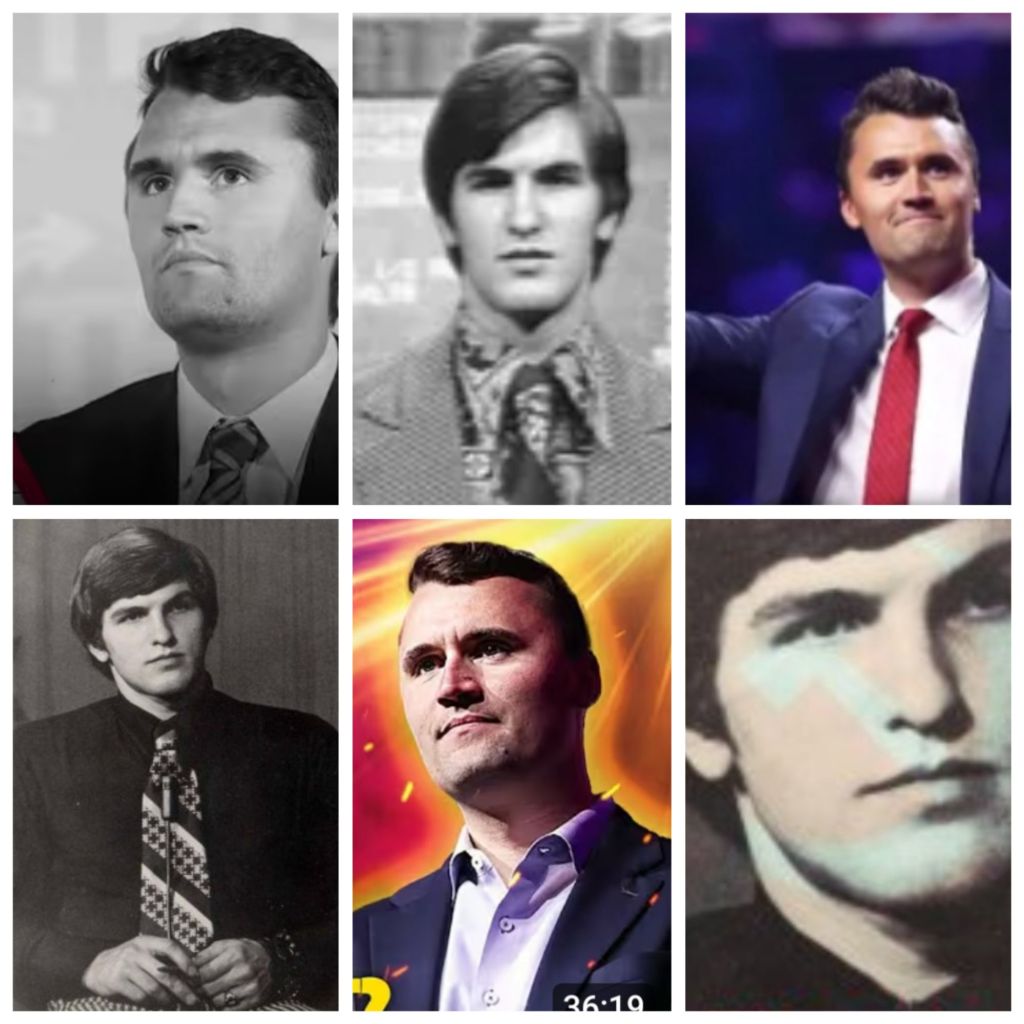
Hence, the events of this past fortnight or so, especially as it concerns learning about the fate of this man called Charlie Kirk, had come to a critically pivotal point for me, as it became a case of “where Charlie meets Sergei”, as though in a mirror! I find it uncanny and perhaps not so merely coincidental at all, that these two men kind of look alike – (see collage photo above). I just couldn’t help but see that resemblance between them. When I first chanced upon a photo of Charlie Kirk only a couple of weeks back, I got a bit of a stunned suprise. It dawned on me then and there that his face bore a resemblance to somebody else I knew of, whose face I had seen somewhere before. It was only a second or two after getting that realization that the recollection came to me: that’s it! Yes! He does!! He reminds me everso much of Sergei Kourdakov! Because for many years I had swept my fascination with, my reverence for Sergei Kourdakov aside, probably because I sensed there were other important matters that needed my attention insofar as probing the depths of my inner life in relationship to God and others went. My teenage years were filled in a strange kind of way, with a fascination about this man Sergei, and a wow’ed preoccupation at times with the amazing, almost improbable facts of his life. He had become for me, in an uncanny kind of way, like Dietrich Bonhoffer, a Protestant saint. He also shared a kind of Pauline-like past re: St Paul’s own conversion story. Both Sergei Kourdakov and Dietrich Bonhoffer were martyrs of sorts as they died because of what they held so dear to their hearts, and that was the centrality of their faith in Christ to the point it enarmoured them in a very specific kind of way, one wherein which they were able to sow many seeds of sacrificial love, the kind of love that bore a sensitively salient, abiding, and uncompromizing witness to the Truth of the One they served and lived to love others through. Our own Maximilian Kolbe was another, and so was the evangelical Protestant missionary Graham Stewart Staines⁷ and his two very young sons Philip and Timothy. See, it’s also very interesting to me because I come from a mixed background both culturally and religiously-speaking, where I was raised Catholic by my mother with the endorsement of my Lutheran father, and so I was treading between “the worlds” so to speak from early on. Although I didn’t realize it then as an adolescent, that this mixed heritage-experience points to a God-ordained purpose for my life to enter into the sacramental well-spring of dialoguing for truth & reconciliation, I have in more recent times been privvy to what this actually means for me personally in relationship to the Church and the wider world. It is taking me to places in my heart and in the everyday facets of life that speak an urgent message loud and clear: that it’s seriously high-time that we collectively as a Church, and as “churches” have to get real about the need for true and lasting bonds of reconciliation to be built among us. For, if such positive bonds chronically wither or keep failing to be built among individuals and groups, disaster in the collective life of churches will come upon great swathes, and particularly those swathes that are stubbornly unwilling to welcomingly respond to the desire on the part of good-willed, severely marginalized individuals (and collectivities too) to reach out to them, endeavouring to seek friendship, fellowship, and through this, healing. This disaster will be a chastizement of sorts and in ways so surprising, ways at that we wouldn’t have ever thought possible. I mean, we already see this emerging, rearing it’s ugly head so to speak. We can already observe through the years, decades, and centuries the tragic consequences all around us of cliquism manifesting in ways that make the fissures of division look hugely seismic, and far too wide in breadth to close up. And God still bears with the throngs of sinful humanity as He cries.
Hence a tale looms large, one of spiritually symbolic proprtions as told through the recent shooting incident resulting in the death of Charlie Kirk, which is truly a stark reminder that the unsung hero in Sergei was being Divinely positioned through Charlie so that people can wake up more fully. More fully to what exactly? More fully to recognising that in the slipstream of faith-life, regardless of whether it hails from the Latin, Greek or other Eastern traditions or one of the Reformed traditions, it is still faith-life, and it is still honouring to God and spiritually nourishing to humanity and the rest of creation. It is perhaps one of the most moving and beautiful things when we hear of Catholics edifying or speaking well and good about our Protestant or even Orthodox brothers and sisters or when we hear Protestants or Orthodox do likewise relative to Catholics instead of either camps revelling in vitriolic vindictiveness or sectarian bigotry. It is not a SIN for someone else to be Protestant just because you happen to be Catholic or vice versa. And neither should it be considered a sin for a Catholic to honour God in a Protestant church on account of being invited by friends or family to fellowship together with them. But for far too long, man-made trends in certain cultural spheres or milieus have set up walls that divide further instead of sow seeds of fraternal dialogue and friendship-building. I had read in one of the comments under Fr Chris Alar’s YouTube video Charlie Kirk: Why? that said Charlie was apparently visiting Catholic churches and presumably doing some inter-faith dialogue there. Now, that’s laudible. I wonder too how laudible such an action would appear to other Catholics if a Catholic was to visit Protestant churches every so often for the same reconciliatory reasons? I would hope that it would not be frowned upon or taken to be circumspect but instead looked upon as similar to how Charlie visited Catholic churches from time to time, to participate in the liturgy and to spread some word no doubt about his own evangelistic ministry. Rumors had been floating about concerning Charlie’s supposed leanings towards conversion to Catholicism. I’ll leave that at that – just rumours. Because it should not be presumed that just because someone visits the spiritual terrain of another denomination or whatever, this automatically signifies that the person visiting is now going to drop their current spiritual convictions and take up others in their place. I think as tragically popular as such presumptions have been in the past, they do not in truth, reflect the reality of how that person, who visits another denominational terrain apprehends, their own spiritual life. And they are, these presumptions just that – like rumours being rumours, presumptions are nothing more.
And so, I think in many ways too, the Catholic Church’s current perception of Protestant voices is, thankfully much more positively integrated and welcoming in our time (at least in the echelons of Vatican leadership) than it was back in the 1970s when the charters of Vatican II were just beginning to ground-swell a little more momentum for what they could definitively offer us in terms of seriously doing Nostra Aetete. Now, those first seeds sown back then seem to have borne fruit, and some darn good fruit at that. That said, we still have a very long, enduring journey ahead.
Major References:
¹ Charlie Kirk: Why? Fr Chris Alar Makes an Interesting Connection, from YouTube, here’s the link: https://youtu.be/RobA-j8yMJ0?si=BlKXtAVlCll-_tGD
² Kidd, K., A Rose for Sergei: A Memoir, 2014, Kindle Format, Amazon eBooks.
³ Keswick Bookshop was the former name of the now renamed (in Australia anyhow) Koorong Bookstore. It got it’s original name Keswick from the famous Keswick Convention, which was a series of evangelical Protestant Bible Study conferences and workshops actually focused on promoting interdenominational unity! The motto of these conventions is All One In Christ Jesus. They began in 1875 in the lakeside English town of Keswick at the inspiration of Anglican Canon T.D. Harford-Battersby and Quaker Robert Wilson, and later spread internationally far and wide.
⁴ Kourdakov, S., The Persecutor, 1974, Fleming H Revell Co., Michigan.
⁵ See blog post from 3rd September, 2025,The Dangerous Banality of Smug Indifference, URL link to this post: https://myfaithandlifeblog.com/2025/09/03/the-dangerous-banality-of-smug-indifference/
⁶ CBS News, The Northern Lights to be Visible Across 18 U.S. States in September 2025, see URL here: https://www.cbsnews.com/news/northern-lights-visible-september-2025/
⁷ Graham Stewart Staines was an evangelical Protestant missionary from Queensland, Australia who along with his two young boys, Philip and Timothy, was murdered in 1999 by a raging mob linked with the Hindu extremist terrorist group Bajrang Dal
Discover more from My Catholic Blog
Subscribe to get the latest posts sent to your email.
 My Catholic Blog